

|
|
 Komodo Dragon |
Komodo Dragon(Reptile) |
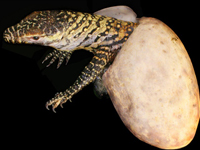 Komodo Dragon Baby |
Komodo Dragon HabitsThe small Idonesian islands on which the Komodo dragon lives are hilly and sparsely covered with rainforest. The lowland areas consist mainly of open grassland and palm tress. Despite their small size, these islands support a wide range of subtropical plants and animals.
Komodo dragons, like most cold-blooded reptiles, sleep during the night. As the sun rises and warms their blood, they become active, awaking from their resting places among tree roots and rocks and set out in search of food.
Despite their great size, Komodo dargons are quick-moving and agile on the ground. They occasionally climb trees, gripping them with their large, powerful claws. They are also good swimmers, taking long, powerful strokes with their tails.
When the usually solitary Komodo dragons meet, they establish a clear pecking order based on size. |
Komodo Dragon CommunicationOne way that they communicate is by hissing. They will hiss if they need to while they are eating or during attacks. A female will often hiss while mating. They also use posturing as a means of signalling their intentions. |
Komodo Dragon BreedingKomodo dragons mate in late June or July. During this period, males may come into conflict with each other as they defend their territories.
Five weeks after mating, the female digs a hole in the warm, moist earth and an average of a dozen eggs. The exact number and size of the eggs she lays vary depending on the age and size of the female. She then covers them and leaves them to incubate unattended, relying on the sum to keep them at the proper temperature.
The young dragons hatch eight months later. Barely eight inches long, they are in danger of being eaten by almost every predator on the islands, from snakes and birds of prey to larger Komodo dragons. Those that survive grow quickly, and after five years, they will have reached six feet in length. Both males and females are mature enough to breed at around six years of age. |
Komodo Dragon Food & Feeding Komodo dragons will eat anything they can catch and overpower, including other Komodo dragons. Favorite prey include wild pigs, deers, and monkeys.
Though Komodos can move quickly, they can do so only over short distances. So they hunt by ambush, waiting for prey to wander into range, then seizing it in their jaws.
Younger Komodos are more mobile than adults, and they will actively hunt small mammals, nestling birds, and insects. Once prey is caught, the Komodo holds it in its claw and rips off chunks of flesh with its teeth. Komodos also eat carrion. |
Komodo Dragon Key Facts |
| Size |
| Height: Length: Males, 10 feet. Females, slightly smaller |
| Weight: Adults, 220-300 pounds |
| Breeding |
| Sexual maturity: 6 years |
| Mating: June or July |
| Gestation: Incubation period of 8 months |
| Number of young: Average of 12 eggs |
| Lifestyle |
| Habit: Usually solitary, but come together to breed and to feed on carrion (dead flesh) |
| Diet: Small mammals, pigs, deer, and monkeys |
| Lifespan: Estimated at 20 years |
DID YOU KNOW?
|
CAN'T FIND WHAT YOU'RE LOOKING FOR? CLICK HERE!!!