

|
|
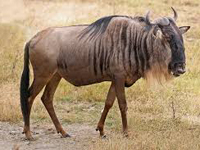 Wildebeest |
Wildebeest(Mammal) |
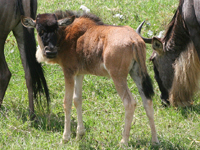 Wildebeest Baby |
Wildebeest HabitsAlthough it looks frightening, the horned wildebeest is neither aggressive nor particularly dangerous. When approached, it will stab the ground with its horns, stamp its hooves, and trash its tail menacingly. It may even lower its head and pretend to charge. But if this display fails stop the intruder, the wildebeest will retreat and repeat its performance from a safe distance. Territorial battles between males involve a similar confrontation. Trespassers are first threatened with loud bellowing calls. If this warning is ignored, the pair meets in a head-to-head trial of strength. Horns may lock, but the fights are rarely bloody. The wildebeest usual response to danger is flight. Wildebeest live in a herds of up to 100 animals. If a herb member spots danger, such as a pride of lions out hunting, it sounds a warning and the whole herd flees.
The wildebeest is hunted for its skin, which makes a durable leather, and its tail, which is used to make fly swatters called chowries. Some hunters also shoot wildebeest for sport. During the 19th century the Boer farmers killed black wildebeest to provide meat for their workers and turned the hides into bags, belts, and other accessories. The massacre continued until 1870, when only 600 of the animals remained. The species was saved by two Boer landowners, who kept breeding herds on their lands, thus enabling the population to recover. Because the wildebeest has the same diet as domestic cattle, it is seen as competition for grazing land in some areas. |
Wildebeest CommunicationWildebeest communicate visually, vocally, and through olfaction. A male's bellow can carry up to 2 km. Preorbital and pedal gland secretions are important in olfactory communications, along with urine and feces. Pedal glands allow herds to follow one another during migrations. Wildebeest rub their preorbital glands and faces on the behinds of others for social contact. Individuals may also sniff and rub their nose and neck on other individuals. |
Wildebeest BreedingThe breeding habits of the wildebeest vary depending on whether it belongs to a traveling herd. Traveling herds contain animals of all ages and both sexes. The mature male may establish a breeding territory and mate with any females entering it. Sedentary (non traveling) wildebeest tend to be more organized. Females with young form separate herds of 10 to 1,000. Males leave the female herds when they are about year old and join separate bachelor groups.
At the age of three or four the male leaves the group and attempts to establish territories of his own. These territories may be held only briefly while the female herd is passing, or they may be maintained for many years. A female will then attempt to mate with any mature female that enters his territory. The young are born at the beginning of rainy season when food is most abundant. A wildebeest calf can stand within 15 minutes of birth and can run shortly after. Until the calf is weaned, at about nine months, it stays close to its mother for protection. But the calves are easy prey for large predators such as lions, and many die. |
Wildebeest Food & FeedingThe wildebeest lives in fertile plains and open woodland, where it grazes on short sweet grass. A taste for this type of grass often leads the wildebeest to recently burn areas, where the fire has cleared the tall, dry scrub, allowing shorter grass to grow. The wildebeest may also follow behind other grazing animals that eat the taller, coarser vegetation. It also eats succulent plants and browses on karroo bushes. It begins grazing soon after sunrise, rests briefly at midday, an continues feeding until sunset. Although wildebeest are know for their seasonal migrations, not all wildebeest migrate. If there is a constant supply of fresh green grass, they remain in the same area all year. Only when there is severe seasonal drought does the wildebeest migrate in search for food. Herds of over 1,000 animals may then thunder over the plains, raising dark clouds of dust visible for many miles. Hundreds die on these journeys. Many drown as they try to cross-flowing rivers. |
Wildebeest Key Facts |
| Size |
| Height: At shoulder, 3-4 1/2 feet. Length: Head and body, 5-8 ft. Tail, 14-22 in |
| Weight: Males, 400-600lb. Females, 300-360 pounds |
| Breeding |
| Sexual maturity: 2-3 years |
| Mating: February to April in South Africa; April to May in the Serengeti |
| Gestation: 8-9 months |
| Number of young: Usually 1 |
| Lifestyle |
| Habit: Lives in herds; often migratory; active by day |
| Diet: Grasses and succulents |
| Lifespan: 21 years in captivity |
DID YOU KNOW?
|
CAN'T FIND WHAT YOU'RE LOOKING FOR? CLICK HERE!!!