

|
|
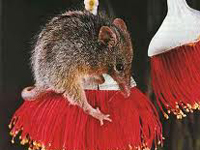 Honey Possum |
Honey Possum(Mammal) |
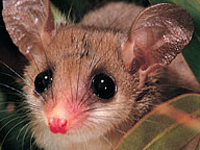 Honey Possum Baby |
Honey Possum HabitsThe honey possum sleeps during the day, either hidden by low-growing vegetation or tucked into a hollow branch. It comes out to feed at dusk. Its body is well adapted for climbing and it can run quickly on the ground.
Most honey possums live in a small home range, traveling across the area during the year to feed on different species of plants as they bloom. The home ranges overlap, except those belonging to breeding females. Females keep other honey possums out while having their young.
During cold weather when food is scarce, the honey possum enters a temporary state of hibernation (inactivity) in which its body temperature and metabolic rate drop. |
Honey Possum CommunicationLittle is known of communication in honey possums. In other possum species, it has been suggested that secretions from the holocrine gland are used to mark habitats and signal alarm. There is evidence indicating that honey possums may use scent marking to attract potential mates. |
Honey Possum BreedingBreeding takes place through-out the year. Few litters are born in December, thought, because few plants are in flour, so food is scare. Peak months for births are January and February. Slightly lower peaks occur at three-month intervals, which is the time needed to raise litter. The births are carefully timed to match the availability of flowers and food.
Like the kangaroo, the female honey possum can keep her fertilized eggs in a dormant state so that a second litter can be born as soon as the first is out of the pouch and weaned. This method ensures that the young possums reach maturity when is the plenty of food.
The female gives birth to two or three tiny young and suckles them in her pouch. The pouch has four teats, but litters of young are unusual. The young remain in the pouch for about eight weeks until they weigh about one-tenth of an ounce. Their eyes are open and they have a full coat of fur. At this stage, the female leaves the young in a nestoften an abandoned birds nestwhile she feeds. For about 11weeks she returns regularly and suckles them. After a few days, the young begin to follow her on feeding trips. They reach maturity at about six months. |
Honey Possum Food & FeedingThe honey possum feeds on nectar and pollen, using its pointed snout and long, brush-tipped tongue to probe deep inside flowers. It prefers flowers of the genus Banksia that produce large heads of nectar-rich flowers and bloom throughout the year.
The honey possums diet requires it to feed on a broad range of plants that flower at different times of the year.
The honey possum uses its well-adapted hands and feed when climbing a shrub or tree. It is aided by its long, prehensile (capable of grasping) tail. Because the honey possum is so small and light-weighted, it can climb out onto very slender branches in order to feed. Hanging by its tail, the honey possums forelimbs are left free to hold the flowers steady. |
Honey Possum Key Facts |
| Size |
| Height: Length: Males, 2 1/2 - 3 1/2 in tail, 2 3/4 - 4 in. Females slightly larger |
| Weight: Males, about 1/2 oz. Females, slightly more |
| Breeding |
| Sexual maturity: 6 months |
| Mating: Year-round |
| Gestation: About 1 month |
| Number of young: Usually 2 or 3, occasionally 4 |
| Lifestyle |
| Habit: Nocturnal. Sociable, with overlapping ranges. Females can be aggressive toward strangers |
| Diet: Nectar and pollen |
| Lifespan: 1 - 2 years in the wild |
DID YOU KNOW?
|
CAN'T FIND WHAT YOU'RE LOOKING FOR? CLICK HERE!!!