

|
|
 Genet |
Genet(Mammal) |
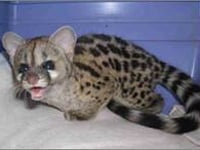 Genet Baby |
Genet HabitsThe genet has adapted to a variety of habitats within its range. It can live in semi-desert, forest, scrubland, grassland, and savannah. During the day the genet sleeps in hollow trees or crevices. Its spotted fur provides good camouflage, so that it blends in wit the surroundings. Active by night, the genet seems to return to the same lair near dawn everyday. |
Genet CommunicationThere are many parallels between the vocal repertoire of genets and cats; both purr, meow, hiss and spit in similar situations. Genets also make churring and yapping noises in stressful situations. In a number of viverrid species a 'lost call' vocalization has been described; young of a litter show a strong propensity to stay together, and if one kitten becomes separated from the others it emits a series of abrupt calls, causing its littermates to run to its location.
Genets have sebaceous anal glands that secrete a substance with a musky odour. Male genets perform handstands while spreading anal secretions on vertical surfaces, and the odor often indicates points where they have urinated. The behavioral role of this scent marking is poorly understood in genets, however, in small-spotted genets marking behavior may permit recognition of conspecifics and their physiological state (e.g., female in estrus) using olfactory cues. Male small-spotted genets can distinguish pregnant and non-pregnant females by olfaction of secretions from the flank glands, which appear to be under hormonal control. Unfortunately, the structure and use of these flank glands is not well understood in genets. |
Genet BreedingThe male and female genet come together only to mate. Although most pairs mate when seasonal rains occur, those living in temperate ranges mate year-round. More prey is available after the rains, which means that food is plentiful for the newborn.
Genet In southern parts of the genet's range, the female may bear two litters a year. The female makes a nest in a hollow tree or among rocks, and the young are born there. They are blind at birth but open their eyes after 5 to 12 days. Their mother provides solid food for them at two months of age. The female is fiercely protective of her young . At nine months the young can hunt for themselves, but they are not fully grown until they are two years old. They become sexually mature at four years of age. |
Genet Food & FeedingThe genet is primarily a carnivore (meat eater). It eats most small animals, including rodents, birds, and insects. It hunts at night, with nocturnal moths and beetles being common prey. The genet emerges from its lair at dusk to hunt. It moves stealthily, keeping, low to the ground, with its tail stuck straight out behind. The genet stalks its prey in much the same way that a domestic cat does. It first crouches, with its belly flattened on the ground. As the animal pounces on its prey, the hairs on its bushy tail stand erect, and the genet begins to purr loudly. A skillful climber, the genet often scales trees to catch nesting roosting birds. In summer, when fruit is abundant, the genet adds pears and figs to its regular diet. It returns to familiar hunting grounds at about the same time each year. |
Genet Key Facts |
| Size |
| Height: Head and body, 16-24 in. Tail, 15-21 in |
| Weight: 2-6 pounds |
| Breeding |
| Sexual maturity: 4 years |
| Mating: Year-round. Sometimes 2 litters produced in a single year |
| Gestation: 10-11 weeks |
| Number of young: 1-4, usually 2-3 |
| Lifestyle |
| Habit: Generally solitary, occasionally seen in pairs |
| Diet: Small rodents, birds insects and some fruit |
| Lifespan: 5-15 Years |
DID YOU KNOW?
|
CAN'T FIND WHAT YOU'RE LOOKING FOR? CLICK HERE!!!