

|
|
 Elephant Seal |
Elephant Seal(Mammal) |
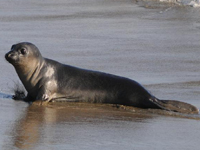 Elephant Seal Baby |
Elephant Seal HabitsWith the exception of breeding season, elephant seals come ashore only to shed their skin, a process known as molting. In late summer, hundreds of seal gather on beaches and wallow in muddy pools of water. They lie close to gather while they gradually shed patches of hair and skin. Eventually, the old skin replaced by a new coat of sleek fur, and the seal return to water.
Originally land animals, elephant seals have adapted to life in the sea by developing a thick layer of insulating fat, called blubber, that keeps them warm. The blubber also serves as a reserve store of food. Elephant seals move gracefully in the water.
They propel themselves with their fins and use their forelimbs to change direction. On land, they use their forelimbs to move across the beach. |
Elephant Seal CommunicationElephant seals communicate though various means. Males will threaten each other with the snort, a sound caused by expelling air though their probosces, and the clap-trap, a loud, clapping sound comparable to the sound of a diesel engine. Pups will vocalize when stressed or when prodding their mothers to allow them to suckle. Females make an unpulsed attraction call when responding to their young, and a harsh, pulsed call when threatened by other females, males or alien pups. Elephant seals produce low-frequency sounds, both substrate-borne and air-borne. These sounds help maintain social hierarchy in crowded or noisy environments and reduce energy consumption when fasting. |
Elephant Seal BreedingMale elephant seal arrived at breeding beaches a few weeks before the females to establish territories. The competition among the males is fierce: they engage in bloody fight to claim territories where females are likely to congregate.
Shortly after the females arrive at the breeding colony, they give birth to single pups conceived in the previous mating season. The females are not ready to mate again until theirs pups are weaned four weeks later. Many larger males attempt to mate with the females too soon after they gives birth; many female are injured, and 10 percent of the pups are killed. Pups triple their birth weight in four weeks. Their wooly fur is then shed to reveal a sleek, gray coat. |
Elephant Seal Food & FeedingElephant seals feed primarily on fish and squid. Until recently, very little was known about their hunting behavior; recent studies have shown that they make extraordinarily deep dives water they catch bottom-dwelling prey.
Although elephant seals have long caning teeth, only thee inch-long tips protrude through the gums. This and their dull molars make it difficult for them to feed on anything but soft-bodied prey, |
Elephant Seal Key Facts |
| Size |
| Height: Length: Southern males, 16 ft,; females, 10 ft. Northern males, 14 ft.; females, 10 ft |
| Weight: Southern males 5300 lb.; females, 1,500lb.. Northern males, 5,00 lb.; females, 2,000 lb |
| Breeding |
| Sexual maturity: 3-5 years |
| Mating: Southern species, September to October. Northern species, December to January |
| Gestation: 11 months |
| Number of young: 1 pup |
| Lifestyle |
| Habit: Social during breeding |
| Diet: Fish and squid |
| Lifespan: Up to 14 years |
DID YOU KNOW?
|
CAN'T FIND WHAT YOU'RE LOOKING FOR? CLICK HERE!!!