

|
|
 Dhole |
Dhole(Mammal) |
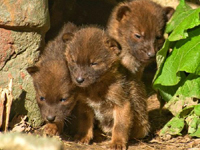 Dhole Baby |
Dhole HabitsThe dhole prefers to live in forested, mountainous country. In parts of its range with no forest , such as Tibet, it lives on the high plains. The dhole lives in a wider variety of climates than any other canid (genus Canidae)- from freezing cold to tropical heat.
Packs of dholes can be made up of one family or several families banded together. Before pray became scarce, the dhole migrated only when its pray did. But in recent years the dhole's territory has expanded, since increasing smaller food supplies have forced it to move farther afield. |
Dhole CommunicationDholes produce whistles resembling the calls of red foxes, sometimes rendered as "coo-coo". How this sound is produced is unknown, though it is thought to help in coordinating the pack when traveling through thick brush. When attacking prey, they emit screaming "KaKaKaKAA" sounds. Other sounds include whines (food soliciting), growls (warning), screams, chatterings (both of which are alarm calls) and yapping cries. In contrast to wolves, dholes do not howl.
Dholes have a complex body language. Friendly or submissive greetings are accompanied by horizontal lip retraction and the lowering of the tail, as well as licking. Playful dholes will open their mouths with their lips retracted and their tails held in a vertical position whilst assuming a play bow. Aggressive or threatening dholes will pucker their lips forward in a snarl and raise the hairs on their backs, as well as keep their tails horizontal or vertical. When afraid, they pull their lips back horizontally with their tails tucked and their ears flat against the skull. |
Dhole BreedingIn its southern range the dhole has no set breeding season. Further north, breeding usually takes place in late winter, with pups born from February to April.
During the breeding season the female makes her den in a cave, a crevice, or a burrow. She often shares it with other females. When she comes into heat, the male pursues her until they mate. The pups are born about 60 days later, blind and fluffy. They grow fast, but their eyes do not open for two weeks.
After a month the pups start being weaned, and they begin to chew on small bits of meat. Six weeks later they become more independent. |
Dhole Food & FeedingThe dhole preys on hoofed mammals. In India it eats deer, wild pig, buffalo, and wild goats; in southeast Asia it feeds on deer, gaur, and banteng; and in Siberia it eats deer, wild sheep, and caribou.
The dhole is a tireless hunter. It tracks its prey at a steady trot for several miles. When the pray is exhausted, the chase is over, and the dhole makes an easy kill. Although one dhole can overtake one deer without assistance, large animals such as the Indian buffalo require a highly organized pack of dholes. Then , some of them distract he pray by biting its head while others attach its flanks and belly.
When the pray is migratory, the dhole migrates too. In Siberia, dholes follow the caribou. They both live high in the Sayan mountains during the summer and move down to lowlands in the winter. |
Dhole Key Facts |
| Size |
| Height: Shoulder Height: About 1 1/2 ft. Length: Head and Body, 3-4 ft.Tail about 1 ft. |
| Weight: Up to 40 lbs |
| Breeding |
| Sexual maturity: Between 12 and 18 months |
| Mating: Usually winter |
| Gestation: About 60 days |
| Number of young: 2-6 |
| Lifestyle |
| Habit: Solitary and nocturnal |
| Diet: Hoofed mammals, small mammals, and birds |
| Lifespan: Up to 16 years in captivity |
DID YOU KNOW?
|
CAN'T FIND WHAT YOU'RE LOOKING FOR? CLICK HERE!!!