

|
|
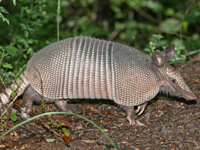 Nine-Banded Armadillo |
Nine-Banded Armadillo(Mammal) |
 Nine-Banded Armadillo Baby |
Nine-Banded Armadillo HabitsArmadillos generally spend the day sleeping in the safety of burrows. They may have as many as twelve burrows located throughout their range, which they dig with their strong front claws, kicking away the excavated dirt with their hind legs.
Each burrow may be from 20 inches to 12 feet below the surface of the ground. The burrow consists of a labyrinth of tunnels that can be as long as 23 feet. Two or more of the tunnels have nest chambers, which the animal lines with grass and weeds.
Nine-banded armadillos will share their burrows only with members of the same sex. Each animal has its own territory, but those of males often overlap. Territories are marked with scent.
Days are spent in whichever burrow is nearest at the end of the night's wanderings.
The hard bone plates covering the body provide effective armor against attack. The plates are arranged in bands over the middle of the back and are attached to flexible skin. Fore and hind limbs have strong, curved claws for digging in the ground Armadillos dig to find food, to make nest burrows, and to escape predators such as jaguars, pumas, and coyotes. The armadillo's underside has no armor. The nine-banded armadillo protects itself by lying flat on the ground with its legs tucked under the shields on its shoulders and hips. |
Nine-Banded Armadillo CommunicationArmadillos communicate with each other using chemical smells.
Armadillos are almost silent, but they can make noises such as low grunts or squeals. |
Nine-Banded Armadillo BreedingMating takes place during the summer, but the exact time varies according to location. Since armadillos have poorly developed senses of sight and hearing, it is thought that the males rely on their sense of smell to detect when a female is ready to mate.
After mating, the fertilized egg is not implanted into the female's uterus wall for 3 months. This delays the birth of the young until the following spring, when more food is available. |
Nine-Banded Armadillo Food & FeedingAt night, the armadillo emerge from its burrow to look for food: insects, small animals, birds' eggs, fungi, roots, fruits, and carrion (rotting animal flesh). It uses its strong sense of smell to detect food. Its long snout has particularly sensitive nostrils.
In the southern parts of its range, the nine-banded armadillo feeds on ants and termites. It pokes its long, sticky tongue into the nest holes and draws out both the insects and their larvae.
If food is detected underground, the armadillo begins to dig frantically. It uses its powerful forelegs to loosen the soil and, balancing on its forelegs and tail, kicks away the dirt from beneath its body using its hind legs. |
Nine-Banded Armadillo Key Facts |
| Size |
| Height: Body, up to 32 inches long. Tail, up to 14 inches long |
| Weight: 12-15 pounds |
| Breeding |
| Sexual maturity: 6-12 months |
| Mating: Summer months |
| Gestation: 120 days after delayed implantation |
| Number of young: Always 4 identical young of the same sex |
| Lifestyle |
| Habit: Nocturnal, solitary, and burrowing |
| Diet: Insects, small animals, birds' eggs, roots, fruits, and carrion |
| Lifespan: 12-15 years |
DID YOU KNOW?
|
CAN'T FIND WHAT YOU'RE LOOKING FOR? CLICK HERE!!!